Every few months, someone in the industry raises the Australian Made question again. Usually it's framed as a values debate: support local, back Australian manufacturing, do the patriotic thing.
It's a fine sentiment. It's also not why most specification decisions get made.
The more useful conversation is a quieter one, and it's happening in project meetings rather than on LinkedIn. It's about risk. Specifically: what happens when an imported product doesn't turn up on time, doesn't meet Australian Standards, or costs 40% more next quarter than it did this one.
That's the conversation worth having honestly, before the marketing season starts telling everyone what to think.
The numbers nobody's arguing about
Start with the uncomfortable fact: imports still dominate. Roughly 60% of Australia's yearly $6 billion spend on construction materials is imported [Epic Sourcing], with China the dominant source. Under the China–Australia Free Trade Agreement, most building material categories qualify for 0% duty, and the landed cost advantage of Chinese imports can still run 30 to 50% below Australian-distributed equivalents, even after freight.
That gap is large enough to explain most of the market on its own. Price still wins most specification conversations, and no amount of "buy local" messaging changes that arithmetic on a tight project budget. Any honest article on this topic has to start there, not skip past it.
But the ground underneath that arithmetic is moving
Here's where it gets more interesting. The supply chains that made those imported prices reliable are starting to crack.
In some sectors, delivery costs have risen by more than 50%. Manufacturers are reporting raw material price increases of up to 50%, particularly in energy-intensive product categories. And it's not isolated: 47% of Australian industrials are now experiencing supply chain disruptions [Australian Industry Group Report 2025], up from 35% in late 2024.
None of that shows up in a per-unit price comparison done in isolation. It shows up three months later, as a delayed shipment, a substituted product, or a variation claim. The apparent 30 to 50% saving on paper doesn't account for what happens when the container doesn't arrive on schedule.
This isn't a fringe concern. When the Australian Institute of Architects called for a national construction supply chain strategy, then-national president Tony Giannone pointed to exactly this pattern: the industry has already seen the pitfalls of relying heavily on international suppliers, from materials shortages through to the earlier safety risks with products like flammable cladding. He also flagged the flip side for local manufacturers, warning that rising insurance premiums and exclusions are threatening many Australian businesses at the same time.
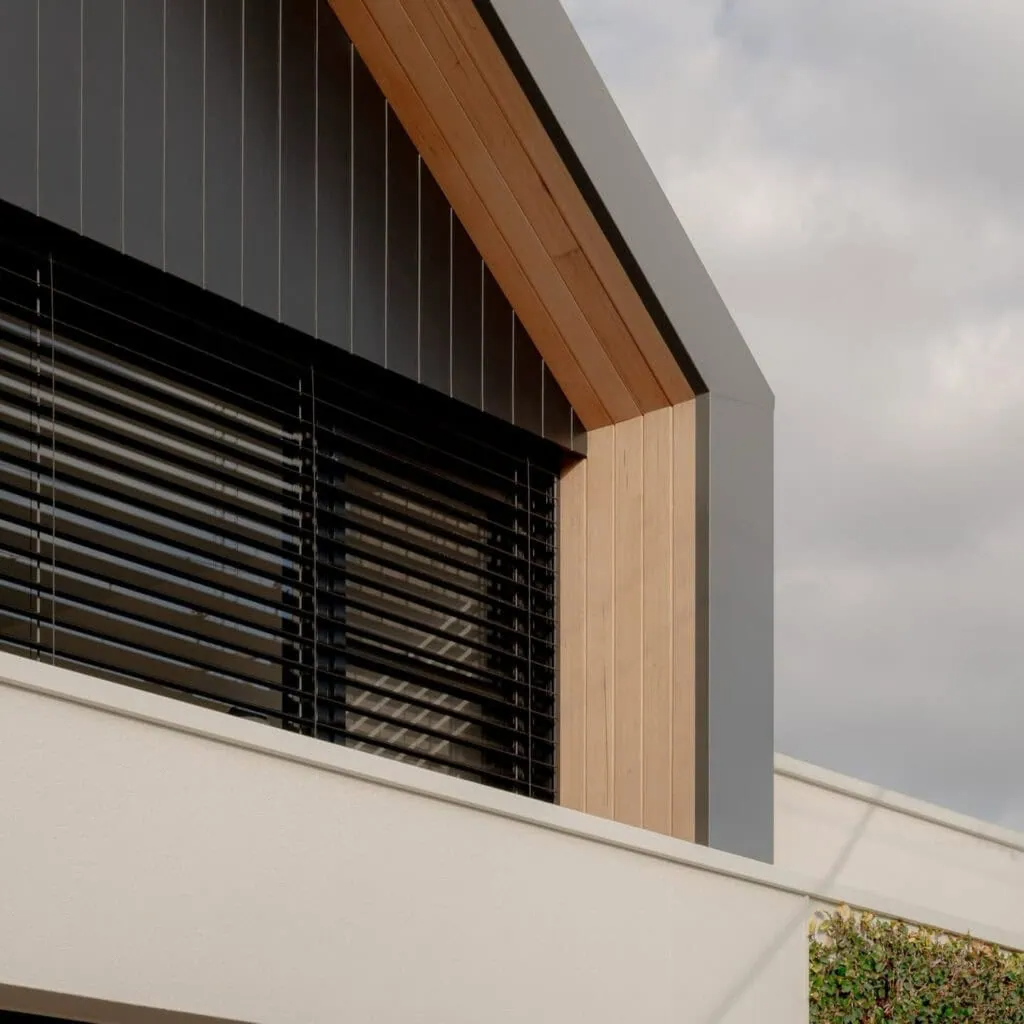 Photo: evaya - external venetian blinds. Project: Adelaide. Architect: Proske Architects
The sharpest argument isn't patriotism, it's liability
For architects and specifiers, the more pressing issue isn't cost at all. It's compliance.
As Peter Mulherin, managing director of compliance verification firm ProductWise, puts it: ensuring product compliance at the certification stage is extremely difficult, which is why non-compliant products need to be kept out of the supply chain in the first place. That's the real argument for specifying local with clear documentation, rather than trying to catch problems at sign-off.
Overseas-sourced materials failing to conform to Australian Standards is a documented, ongoing problem, and it isn't limited to cladding. Non-compliant imported product can trigger fines, stop-work notices, or forced removal and replacement, well after a project has been signed off and handed over.
That's a professional indemnity exposure, not just a project cost. A locally manufactured product with clear, traceable compliance documentation is a materially lower-risk specification, regardless of how anyone feels about the "Australian Made" label. This is the argument that actually holds up in a risk review, and it's the one most Australian Made messaging doesn't lead with.
What architects are actually asking suppliers for
Talk to architects directly and the ask is rarely ideological. It's practical:
- What's genuinely stocked locally, versus what's imported and re-badged
- Where the realistic pinch points are in a supply chain, before they become a program problem
- Lead times that are accurate now, and updated promptly the moment they change
That's it. Nobody is asking suppliers to be patriotic. They're asking them to be straight about risk, because the architect is the one who has to explain a six-week slip to a client, not the supplier.
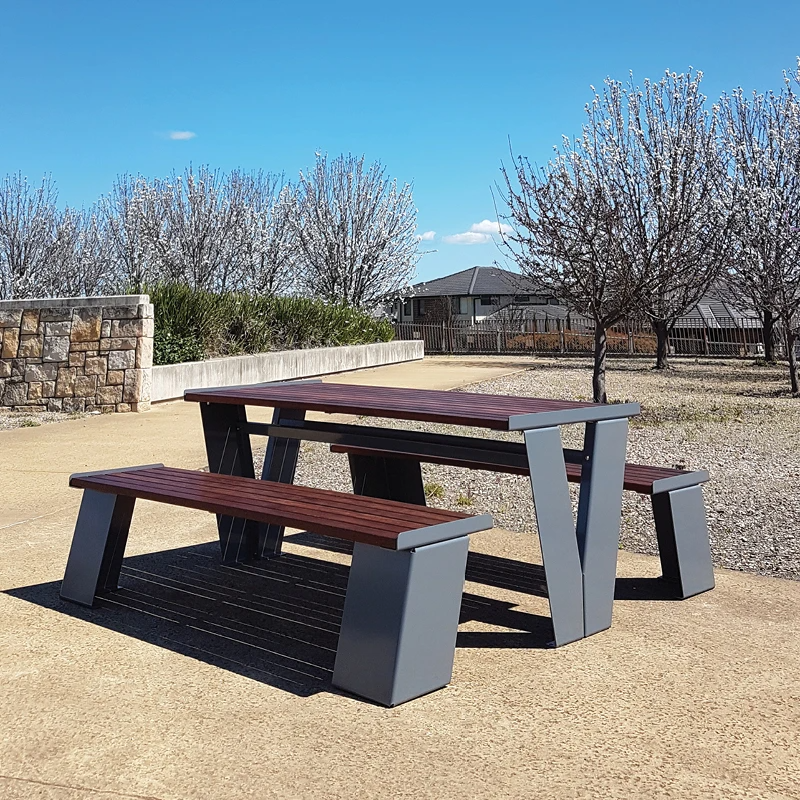 Photo: Astra Street Furniture - Paris Setting with Flat Benches - Merbau Hardwood. 100% Australian-made.
Where this leaves 2026–2027 specification decisions
The products carrying the most cost and schedule volatility into 2026 and 2027 share a profile: long lead times, energy-intensive manufacturing, and freight-sensitive logistics. That's exactly the profile of a lot of imported building product right now.
Locally made product with a short, direct delivery chain doesn't have that exposure. On time-critical or risk-sensitive projects, that's becoming a genuine point of difference, and it's a difference that shows up in the program and the CAD file, not just the sustainability section of a submission.
The honest conclusion
Imports aren't going anywhere, and price will keep winning plenty of specification decisions on its own. That's the reality, and pretending otherwise doesn't help anyone make a better decision.
But the calculus is shifting. Supply chain risk, compliance liability, lead time reliability, and embodied carbon are all narrowing the gap between "cheaper" and "better value." Specifying Australian Made is increasingly a smart professional decision, backed by risk management and documentation, not just a values-based one.
That's the conversation the industry is already having. The campaign season that follows should be answering it, not starting it.
Get in touch
If you'd like to talk through where your products sit in this conversation, book a time with our Head of Growth, Nancy Attoh below.
Featured image: AkzoNobel Interpon D Anodic range, Australian made.
Last updated: 9 July 2026







.png?width=352&name=httpshypebeast.comimage20250909i%20(4).png)