

The Case for Adaptive Reuse, And Why It's Changing What Architects Specify
Australia's office towers have never been emptier. In January 2026, the national office vacancy rate climbed to 15.9%, the CBD vacancy rate sat at its highest level in roughly 30 years, and secondary-grade stock is bearing the brunt of it. Premium and A-grade buildings are still finding tenants. B, C and D grade buildings are not.
The Property Council's own data shows secondary-grade office space "experiencing negative demand" while occupiers chase quality, location and performance in a shrinking pool of top-tier stock.
At the same time, building a new home in Australia now costs 47% more than it did before the pandemic (Cotality Cordell Construction Cost Index, December 2025), and commercial construction faces the same pressure from material inflation, trade shortages and compliance costs. Demolishing a sound structure and starting again has rarely looked less attractive.
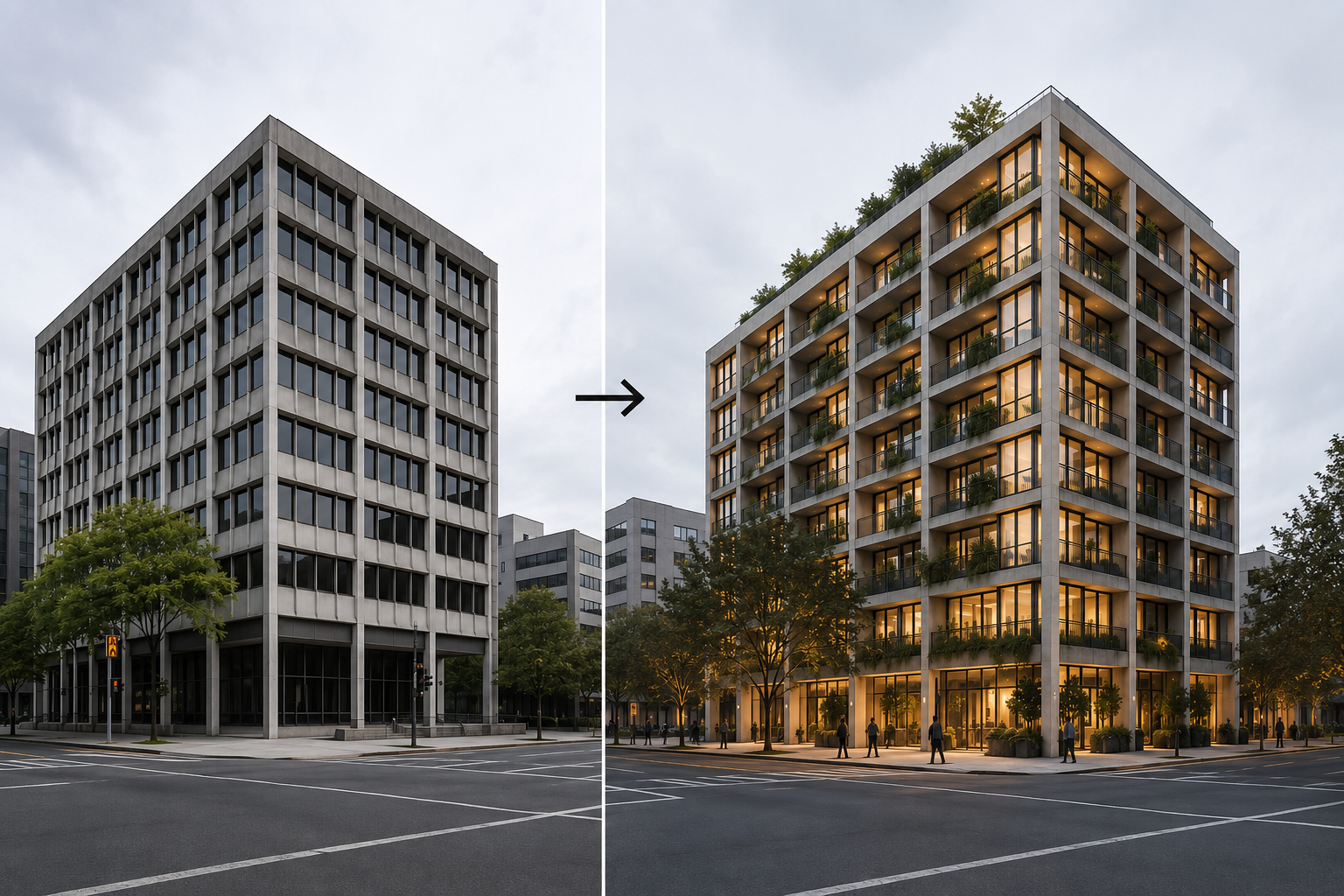
That combination, a glut of underperforming buildings and the rising cost of building anything from scratch, is why adaptive reuse has moved from a heritage niche to a mainstream conversation among architects, developers and government.
The number that changed the conversation
In 2023, Hassell released research conducted for the Property Council of Australia, in partnership with Ethos Urban, that put a hard figure on the opportunity. The study audited Melbourne's CBD and identified 86 office buildings built before 1990 — roughly 6.5% of pre-1990 CBD office stock — that are "ripe for adaptive reuse." If even half were converted, the report estimated they could deliver 10,000 to 12,000 new apartments, housing up to 20,000 people (Hassell; Property Council of Australia).
Hassell Principal Ingrid Bakker, who led the research, put it plainly:
"There's a bit of a radical rethink that needs to happen around looking at these buildings that obviously aren't performing very well because a lot of them are empty."
And on the sustainability case:
"Each repurposed building would use roughly half the upfront embodied carbon compared to knocking existing buildings down and rebuilding."
The whitepaper, Radical Re-Use: From Office to Home, was careful not to oversell the idea. Not every building works. Deep floor plates, awkward column grids and inadequate natural light rule plenty out. But for the buildings that do qualify, the case stacks up on cost, carbon and housing supply at once, which is precisely why the report has kept circulating through property and design circles well into 2024 and 2025, including a spot in LinkedIn Australia's Big Ideas roundup.
The Property Council's Victorian team framed the urgency the same way. Cath Evans, Victorian Executive Director, noted that the "post-pandemic reality poses many challenges for the Melbourne CBD," with strong demand for premium office space leaving "a lot of sub-prime office space… severely underutilised" (Hassell).
Why the economics have flipped
Associate Professor Philip Oldfield from UNSW's School of Built Environment sums up the embodied carbon argument architects are now taking into every early-stage feasibility conversation:
"If we take an existing building and we strip it back to the structure, adaptively reuse it, estimates suggest we'd save around 40 percent of the building's embodied carbon because that's typically what it takes to create a structure." - Australian Design Review
It's not just carbon. It's also the fastest route to delivering usable space in a market where new supply has all but stopped. Property Council CEO Mike Zorbas noted that Australia's current vacancy bump is "largely supply-driven," and that gross new office supply over the next three years will run at roughly half the historical average as the current construction cycle tapers off (Build Australia). Fewer new buildings are coming. The existing stock has to work harder.
Adaptive reuse isn't free or automatic, though. Analysis by Gensler of more than 300 North American offices found only 30% were genuinely suitable for residential conversion - floor plate depth, column grids, floor-to-floor heights and services all have to line up (Altus Group). That's exactly why feasibility, planning reform and the right building selection sit at the centre of every serious industry conversation on this topic, Hassell's included.
Australian examples already on the ground
120 Collins Street, Melbourne - Hassell's revitalisation of this 35-year-old office tower didn't touch the structure but transformed the ground floor and entrance: a new lobby, lush gardens, a glass atrium and sky terrace, and stainless-steel canopies referencing the heritage Professional Chambers building next door. The result wasn't just aesthetic. The Australian Institute of Architects notes the building went from under 40% leased at project completion to 91% leased, "a testament to the Hassell design guided by their industry-leading workplace research" (AIA; Hassell)
171 Collins Street, Melbourne - Working with Charter Hall and Cbus Property, Hassell reimagined the ground floor and level two as a "layered, hospitality-forward environment," adding a boardroom suite, wellness precinct and flexible project rooms. As Hassell puts it, the brief was to make "the office earn its keep" in a market where "a central postcode no longer guarantees a full workplace" (Hassell).
Michael Kirby Building, Macquarie University, Sydney - Hassell's upcycling of this campus building on Dharug Country repositioned an ageing academic asset for interdisciplinary teaching and research, extending its life rather than replacing it (Hassell).
415 Flinders Lane and Invicta House, Melbourne — Plus Architecture's work here involved extensive replanning and a full building reskin at 415 Flinders Lane, plus a new fitout and two-storey roof extension at Invicta House, both converting underused CBD stock into contemporary workplace and residential product (Australian Design Review).
Adelaide's ARCHI program — The City of Adelaide's Adaptive Reuse City Housing Initiative has identified more than 150 buildings across Adelaide and North Adelaide with conversion potential, and now funds feasibility studies and building works — including fire safety upgrades, wet areas and interior finishes — for owners converting vacant space into housing (City of Adelaide).
Each of these projects tells the same story from a different angle: the building envelope stays, but almost everything inside it — surfaces, lighting, ceilings, facades, flooring, services — gets specified again from scratch.
What this means for architects
Adaptive reuse is not a lighter-touch version of new-build specification. In many respects, it's heavier. A ground-up new build lets an architect design services, floor-to-ceiling heights and facade systems around a clean structural grid. A reuse project asks them to solve the same performance, acoustic, fire and amenity briefs inside constraints someone else set thirty or fifty years ago, while still delivering a building that competes for tenants or buyers against premium new stock. That's a harder design problem, and it tends to produce more considered, more heavily documented specification decisions, not fewer.
Facades often need full reskinning to meet current thermal and acoustic performance, as at 415 Flinders Lane. Lobbies and entries get rebuilt from the ground up to reposition ageing assets in the leasing market, as at 120 Collins Street. Lighting and ceiling systems have to work around existing floor-to-floor heights that can't be changed. Flooring has to bridge old structural tolerances with new accessibility and acoustic standards.
What this means for suppliers
For suppliers in surfaces, lighting, facades and flooring, that's the real signal in the vacancy data and the Hassell numbers. Because so much of the value proposition in these projects is embodied carbon savings and sustainability credentials, the materials chosen are increasingly being asked to prove their own environmental performance too. The specification conversation on these projects starts earlier, runs deeper, and rewards suppliers who can speak fluently to both performance and embodied carbon. That's a very different sales conversation to a standard new-build tender.
The signal
The pipeline of reuse and repositioning projects across Australian CBDs is only getting bigger as vacancy stays elevated and new-build economics stay tough. Whichever side of the specification table you're on, it's worth being ready for.
Specifiers, find reuse-ready products through Find A Product.
Suppliers, find out more about our services and how we get your products in front of the architects making these calls.
Fequently Asked Questions
What is adaptive reuse in architecture?
Adaptive reuse is the process of repurposing an existing building for a new function rather than demolishing and rebuilding it — for example, converting a vacant office tower into apartments, or repositioning an ageing office lobby to attract new tenants.
How many Melbourne office buildings could be converted into housing?
Hassell's research for the Property Council of Australia identified 86 pre-1990 office buildings in Melbourne's CBD as candidates for adaptive reuse, with the potential to deliver 10,000 to 12,000 new homes if roughly half were converted.
Why is office vacancy so high in Australia right now?
Australia's national office vacancy rate reached 15.9% in January 2026, and CBD vacancy is at its highest level in around 30 years, driven largely by a wave of new premium office supply completing while demand concentrates in top-grade buildings, leaving B, C and D grade stock underutilised.
Is adaptive reuse cheaper than new-build construction?
It can be, particularly given that new home construction in Australia now costs 47% more than before the pandemic, but adaptive reuse projects still require significant investment in facades, services, lighting and interiors. Feasibility depends heavily on the individual building's floor plate, structure and services.
What does adaptive reuse mean for architects and specifiers?
Reuse projects typically involve heavier, more constrained specification decisions across surfaces, lighting, facades and flooring, since architects must meet current performance standards within an existing structural envelope rather than designing from a clean slate.