The first Pan-African Biennale happened in Nairobi, last week after five days at the Kenyatta International Convention Centre and venues across the city. It is the first continental biennale dedicated to architecture and the built environment conceived and led from within Africa, with at least one practice, collective or individual representing each of the continent's 54 countries.
For Architects & Designers in across Australia, it would be easy to file this under "interesting, but far away". That would be a mistake. Much of what was on show in Nairobi is about building well in heat, drought, flood and material scarcity, using what is available locally. Those are Australian problems too.
Here is what we took from following the week, and why it is worth carrying into your next project.
What the Pan-African Biennale 2026 is
The Pan-African Biennale 2026 is a five-day exhibition and public programme held from 7 to 11 September 2026 in Nairobi, Kenya, under the theme "Shifting the Center: From Fragility to Resilience". It was founded and directed by Somali-Italian architect Omar Degan, and developed with the Architectural Association of Kenya and its president, George A. Ndege.
The main hub was the Kenyatta International Convention Centre, completed in 1973 by Norwegian architect Karl Henrik Nøstvik with Kenyan architect David Mutiso. General admission to the exhibition and talks was free, and each day carried its own theme, from Ecologies of Repair to Pan-Africanism, the Centre in Motion. The biennale moves to a different African city every two years, with the second edition scheduled for 2028.
Lesson one: organise by climate, not by country
The exhibition grouped practices by climatic zone rather than national pavilion. Degan's argument, set out in the Wallpaper* guide to the biennale, is that two practices 2,000 kilometres apart often share a soil, a rainfall pattern and a building material, and that a border drawn elsewhere should not structure the room. Visitors moved through conditions, not countries.
That is a useful way to think about Australia, where the National Construction Code already divides the country into eight climate zones. When you brief a supplier, ask how a product performs in your climate zone, not whether it has been used somewhere in Australia.
Lesson two: earth is a serious material again
Two of the most instructive participants build almost entirely from earth. Hive Earth, founded in Accra, Ghana in 2017, specialises in rammed earth and has delivered a four-storey office building in Accra with Adjaye Associates. Co-founder Joelle Eyeson has said the studio's early research pointed to Australia as one of the places where rammed earth was already well established.
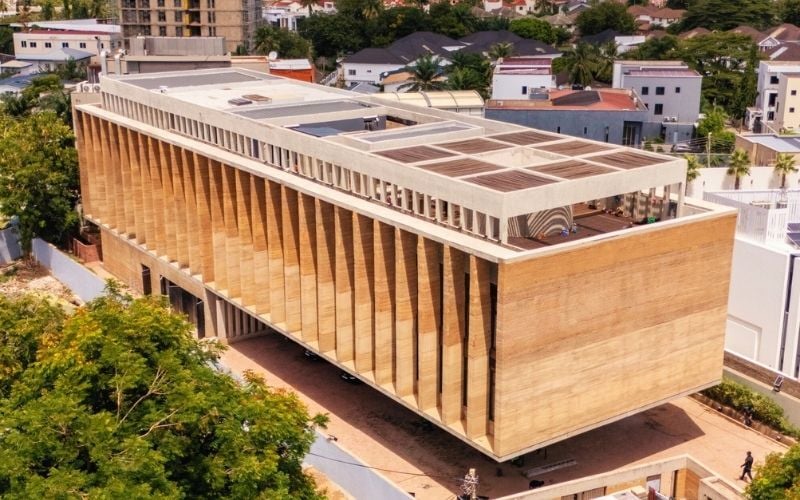
Photo credit: Adjaye Associates studio in Accra
Association La Voûte Nubienne, representing Burkina Faso, promotes a vaulted roof built entirely from sun-dried earth bricks and earth mortar, with no timber, steel or corrugated iron. The technique has been taught to masons across the Sahel since 2000.
For Australian Architects & Designers, the interest is less the technique, which Western Australia has practised for decades, and more the framing. Earth was presented in Nairobi as a mainstream response to embodied carbon and supply cost, not a niche or heritage exercise.
Lesson three: evidence over image
Participants were asked to show evidence rather than image: process, data and material knowledge rather than a curated photograph. There was no open call. The curatorial team selected practices from within, which removed the requirement for each country to fund its own pavilion.
The same standard is worth applying to product selection. Ask suppliers for Environmental Product Declarations, test reports and case studies with numbers attached. A product that can only offer a rendered image has not yet made its case.
Lesson four: the city was the venue
The Kenyatta International Convention Centre hosted the opening and closing, but most of the programme spread across the Ngara district of Nairobi. An Open Offices programme invited visitors into working studios including Cave Bureau, Kounkuey Design Initiative, Localworks, Urko Sanchez and Boogertman + Partners, with no ticket required. An evening film programme at Unseen Nairobi was drawn from an international open call.
The model shows how much a first-edition event gains by letting practitioners host, rather than building everything inside one hall.

Photo: Aerial view of Nairobi, skyline with modern skyscrapers and roads at sunset. Photographed by @youngafrikanna
Lesson five: recognition is being redirected
On 10 September 2026, the Van Alen Institute announced the two Africa-based winners of its Re:Paris Prize, a relaunch of the Paris Prize that ran from 1904 to 1997 and once sent young American architects to study in Paris. Each winner receives a US$35,000 travel fellowship for field research on the continent.
The winners were Tanzanian spatial designer Arafa C. Hamadi, for "Who Designs Knowledge?", a study of exhibition design rooted in African material culture, and the Bled el Abar Collective from Tunisia, for "Ifriqya: A Territory of Hospitality", a mapping of oases, tents and wells across the Sahara. Both will present at Van Alen in New York in late 2027 and at the second Pan-African Biennale in 2028.
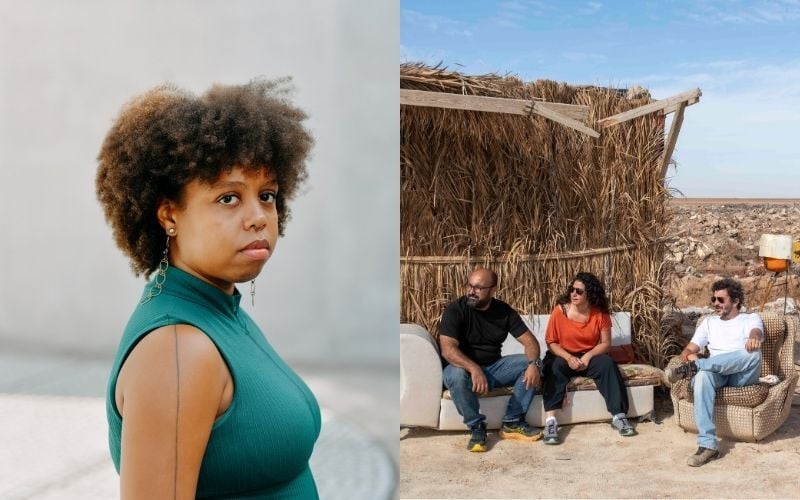
Photo: Winners Arafa C. Hamadi (L) photographer Ramiie G photography and the Bled el Abar Collective (R) photographer M'hammed Kilito as the two Africa-based winners of the 2026 Re:Paris Prize
Why this matters for Australian Architects & Designers
Climate-led material thinking travels. The Sahel, the East African coast and northern Australia share more design constraints than a map suggests, and the earth and passive cooling work shown in Nairobi is directly relevant to projects in Queensland, the Northern Territory and Western Australia.
Provenance is a specification question. Ask building product suppliers where a material comes from, what its embodied carbon is, and whether they can prove it. The biennale's insistence on evidence over image is a good standard for a product presentation too.
CPD relevance is high. Climate-responsive design, low-carbon materials and vernacular construction are all live CPD topics, and Nairobi offers a fresh set of case studies.
Watch 2028. The second edition will be held in a different African city, with the Re:Paris Prize winners presenting their field research there.
New materials, products and design thinking arrive in Australia through events as much as through publications. To see what building product suppliers are bringing to Architects & Designers in your city, come along to an upcoming event, RSVP over at the The-Arc events calendar. All Architects & Designers events are complimentary.
Frequently asked questions
What is the Pan-African Biennale?
+
The Pan-African Biennale is the first continental biennale dedicated to architecture, the built environment and spatial practice, conceived and led from within Africa. It brings together practices from all 54 African countries and the diaspora under a single curatorial framework, and is designed to move to a different African city every two years.
When and where was the first Pan-African Biennale held?
+
The first Pan-African Biennale was held in Nairobi, Kenya from 7 to 11 September 2026. The main hub was the Kenyatta International Convention Centre, with talks, workshops, Open Offices and film screenings spread across other venues in the city, mostly in the Ngara district.
Who curated the Pan-African Biennale 2026?
+
The Pan-African Biennale 2026 was founded, directed and curated by Somali-Italian architect Omar Degan. It was developed with the Architectural Association of Kenya and its president, George A. Ndege.
What was the theme of the Pan-African Biennale 2026?
+
The theme was "Shifting the Center: From Fragility to Resilience". The exhibition was organised by climatic zone rather than by national pavilion, and each of the five days carried its own sub-theme: Shifting the Centre, Ecologies of Repair, Living Archives and Embodied Knowledge, Imagining Otherwise, and Pan-Africanism, the Centre in Motion.
Who won the Re:Paris Prize at the Pan-African Biennale 2026?
+
The two Africa-based winners of the 2026 Re:Paris Prize, announced in Nairobi on 10 September 2026, were Tanzanian spatial designer Arafa C. Hamadi and the Tunisian Bled el Abar Collective. The prize is run by the Van Alen Institute in New York and awards each winner a US$35,000 travel fellowship for field research.
When is the next Pan-African Biennale?
+
The second Pan-African Biennale is scheduled for 2028 in a different African city. The host city had not been announced at the time of writing.
Last updated: 17 September 2026